
The main difference between metal-free dental implants vs titanium implants is the material placed in the jaw. Metal-free implants use tooth-colored zirconia ceramic, while traditional implants use gray titanium or a titanium alloy. Both can integrate with bone and support a replacement tooth, but they differ in clinical history, design options, and appearance.
Metal-free dental implants use tooth-colored zirconia ceramic, while titanium implants use gray metal. Both integrate with bone and support replacement teeth, but titanium has broader long-term evidence and more design options. Zirconia may suit patients wanting a nonmetallic or more esthetic material. The right choice depends on bone, gums, bite, health history, and the planned restoration.
Titanium is the more established and versatile option for many cases. Zirconia is an alternative for selected patients who want a nonmetallic implant or may benefit from a tooth-colored material. The choice depends on the missing-tooth location, bone, gums, bite, health history, and planned restoration. Patients can review Full Smile Dental’s dental implant options before an evaluation.
Metal-Free vs Titanium Implants at a Glance
Both implant materials can replace a missing tooth root, but they should be compared by the same clinical criteria.
| Factor | Metal-free zirconia implant | Titanium implant |
| Material | Zirconium oxide ceramic | Titanium or titanium alloy |
| Color | White | Gray |
| Evidence | Favorable selected-use evidence; less long-term data for newer two-piece systems | Broader, longer clinical evidence |
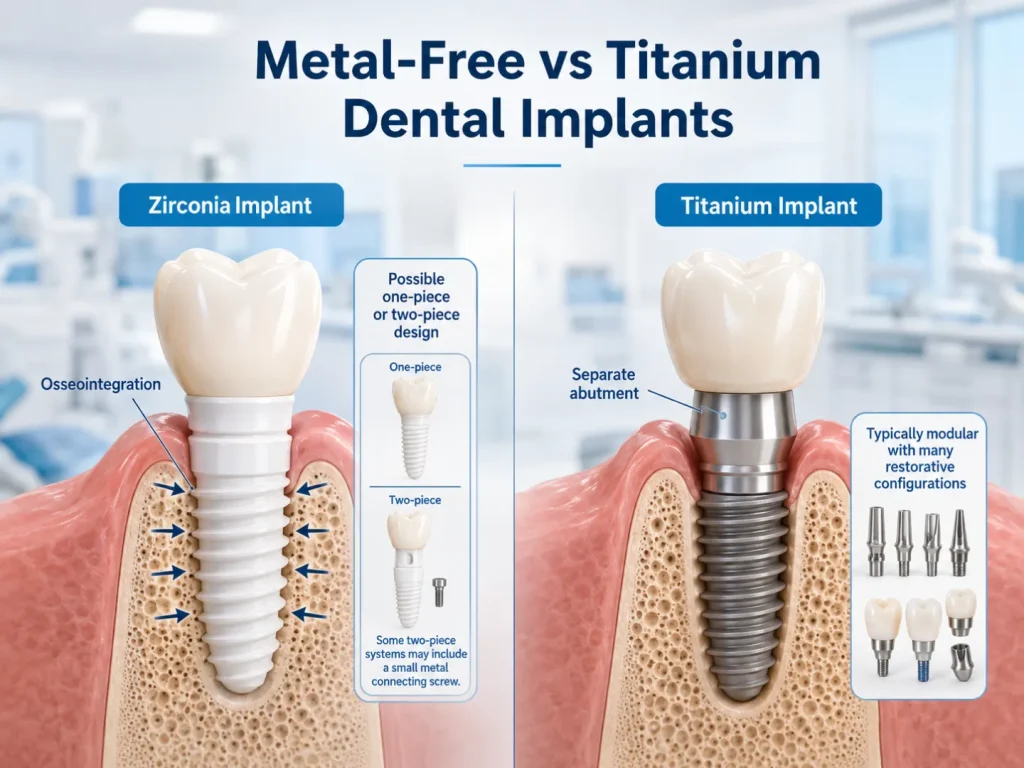
| Design | One-piece or two-piece, depending on the system | Usually modular, with many component choices |
| Flexibility | Depends on the system and available parts | Broad selection of sizes, angles, and parts |
| Maintenance | Daily cleaning and professional monitoring | Daily cleaning and professional monitoring |
The U.S. Food and Drug Administration identifies titanium and zirconium oxide as the materials used in most implant systems and explains that implant materials undergo biocompatibility evaluation.
What Is a Metal-Free Dental Implant?
A metal-free dental implant has an implant body made from zirconia, a strong oxide ceramic. Zirconia is white, and its surface can join with bone through osseointegration, the process that stabilizes an implant in the jaw.
“Metal-free” needs a component-level explanation. Some zirconia implants are one piece, while certain two-piece systems use a metal connecting screw. A patient seeking complete metal avoidance should ask about the implant body, abutment, screw, and crown. Full Smile Dental explains its metal-free dental implant option separately.
What Is a Titanium Dental Implant?
A titanium dental implant is a metal implant body placed in the jaw to support a crown, bridge, or denture. Most systems use a separate abutment, allowing the dentist to select parts for the position, angle, space, and bite.
Titanium has been studied clinically for longer than zirconia and is available in many sizes and restorative configurations. Its gray color normally remains below the gumline, although color can matter when gum tissue is thin or recedes.
How Do Zirconia and Titanium Implants Differ in Practice?
The practical differences involve appearance, evidence, system design, and the treatment plan. Neither material is always better.
Appearance and Gum Tissue
Zirconia’s tooth-colored appearance may reduce gray show-through beneath very thin gums, particularly near a front tooth. Final appearance also depends on implant position, bone support, gum thickness, the abutment, and the crown.
Clinical Evidence and Design
Titanium has broader long-term evidence and more restorative configurations. A 2023 International Team for Implantology consensus statement found favorable five-year performance for studied zirconia implants in selected uses, but noted that most longer follow-up involved one-piece systems. Evidence for newer two-piece designs remained limited.
Strength and Mechanical Planning
Both materials can fail. Zirconia systems differ in mechanical properties, and not every design has the same level of clinical validation. Implant diameter, position, tooth location, grinding or clenching, and the selected system must be matched to the forces expected at the site.
Are Metal-Free Implants Better Than Titanium Implants?
No implant material is better for every patient. Titanium may be preferred when a case requires broad component choice, angled correction, a complex bridge or denture, or the deepest evidence base. Zirconia may fit a patient who prefers a nonmetallic material or has an esthetic concern, provided the available system fits the clinical plan.
Zirconia has not been shown to prevent peri-implantitis better than titanium. Accurate placement, healthy tissues, a cleansable restoration, controlled bite forces, plaque removal, and professional care matter with either material.
What Determines Which Implant Material Fits You?
A dental examination determines whether either material fits the site and restoration. Important factors include:
- Jawbone: The site needs enough support for a stable, functional restoration.
- Gums: Active disease needs attention, and thin tissue may make material color more relevant.
- Position and bite: Front-tooth esthetics and back-tooth forces create different priorities.
- Restoration type: A crown, bridge, full-arch restoration, and denture require different components.
- Healing factors: Health, smoking, diabetes control, medications, and dental history can affect planning.
- Material preference: Confirm whether “metal-free” applies to the implant body or every component.
An examination and appropriate imaging are necessary because a preference alone cannot confirm candidacy.
Do the Risks and Maintenance Requirements Differ?
Both implants involve surgery and share risks, including injury to nearby structures, infection, delayed healing, looseness, cleaning difficulty, and nerve-related numbness. Material choice does not remove these risks.
Both options require daily cleaning and professional monitoring. Contact a dentist if an implant becomes painful or loose, or if swelling, drainage, persistent bleeding, or a bite change develops. These findings require an examination.
Compare Your Implant Options at Full Smile Dental
Metal-free zirconia and titanium implants can both be appropriate. Full Smile Dental can examine the missing-tooth area and explain the material and component choices from its Worth, IL office. To take the next step, request an implant evaluation or call 708-448-0468.
Frequently Asked Questions
Can zirconia implants last as long as titanium implants?
Zirconia implants have favorable five-year data for certain, mainly one-piece designs. Titanium has a larger long-term evidence base, so equal longevity cannot be assumed for every zirconia system or use.
Can someone be allergic to a titanium dental implant?
A dentist or physician should evaluate a suspected reaction because symptoms around an implant can have several causes.
Do zirconia implants look more natural?
Zirconia is tooth-colored and may limit gray show-through beneath thin gums. The visible result also depends on the crown, implant position, bone, and tissue stability.
Are all zirconia implant systems completely metal-free?
No. Some two-piece zirconia systems include an internal metal screw or another metal component. Ask about every part if complete metal avoidance is important.